When searching for information on facial lifting devices, many people often encounter a variety of technology names from different brands. The devices differ in how they work, how deeply they deliver energy, and which concerns they may address, whether it’s sagging cheeks, undefined jawlines, loose skin, or loss of firmness. Therefore, choosing a lifting device shouldn’t be based solely on the name or popularity, but should also consider its suitability for each individual’s skin condition and facial structure. This article, written by the medical team at OPPA SKIN CLINIC, introduces readers to six popular facial lifting technologies currently available, comparing them by technology group, energy depth, time to see results, and suitability for different skin problems. This information will help readers make an informed decision before consulting with a doctor and choosing the most suitable program for their needs.
6 Popular Skin Tightening Devices
The following comparison covers both OPPA SKIN CLINIC’s programs and equipment from various brands to provide an overview of the options. It does not mean that the clinic offers every machine mentioned; the details of each model and the heads used must be considered separately.
1. Ultraformax program
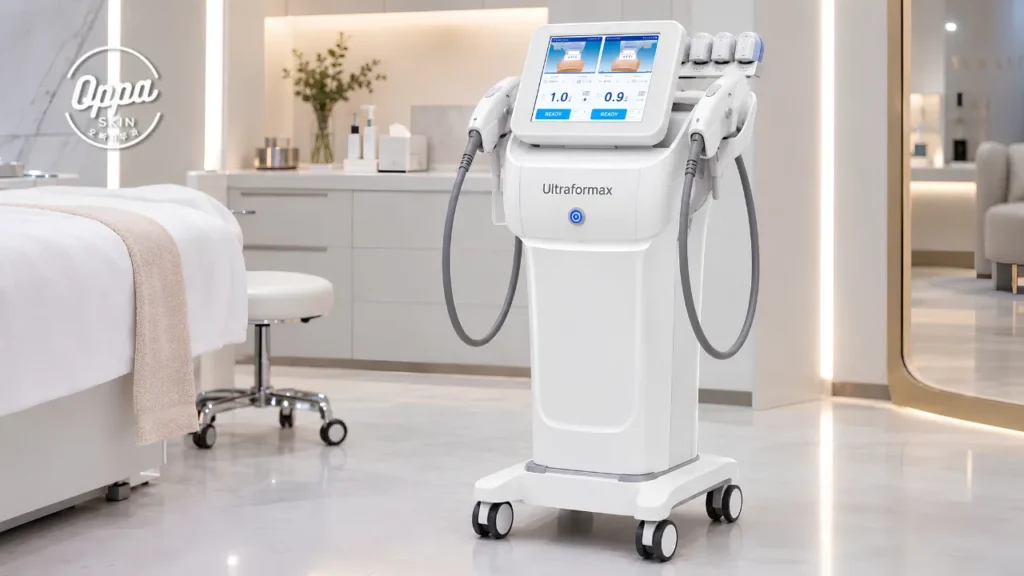
The Ultraformax program is a High Intensity Focused Ultrasound (HIFU) technology that delivers focused energy to the skin and SMAS layers without damaging the upper skin layers. The principle of operation is to stimulate localized heat in the deep layers, thereby stimulating the production of new collagen beneath the skin. This is one of the main skin tightening programs used by OPPA SKIN CLINIC to treat sagging skin in patients.
2. Ultherapy Program
Ultherapy is a HIFU technology, similar to Ultraformax, belonging to the Focused Ultrasound group. It’s one of the long-established HIFU technologies in the dermatology field, notable for its adjustable transducer head to determine the energy depth targeting specific skin layers. It’s suitable for those seeking deep skin tightening similar to Ultraformax.
3. Thermage Program
Thermage program uses monopolar RF radio frequency technology to deliver heat energy over a wide area of the skin, instead of focusing it on a single point like HIFU. The principle of operation focuses on uniform heat distribution across the treated area to stimulate the contraction of existing collagen and promote the long-term production of new collagen.
4. XTherma Program
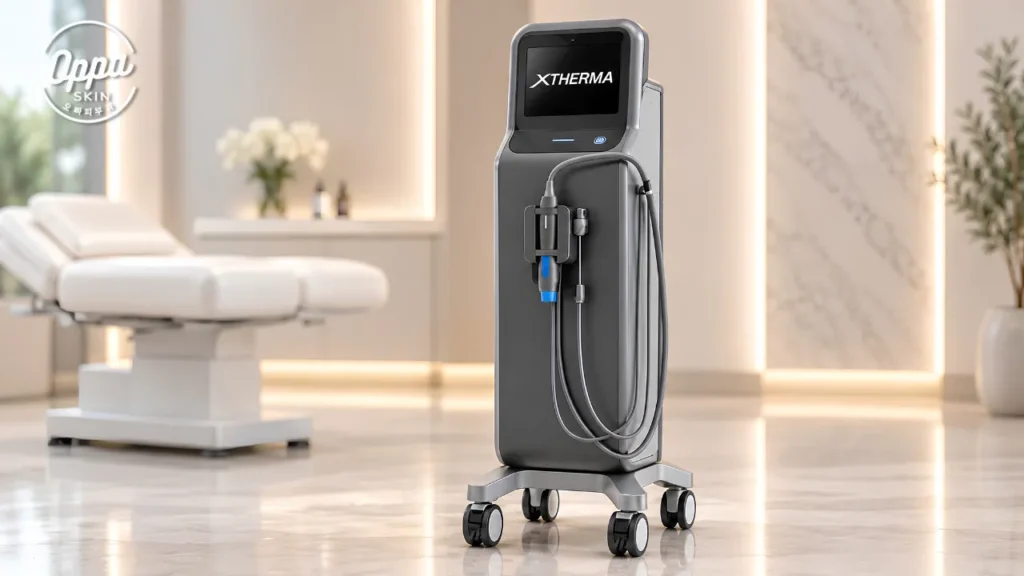
The XTherma program is another radio frequency (RF) technology offered by OPPA SKIN CLINIC for skin tightening. It delivers thermal energy to the skin layers to stimulate collagen and elastin production, resulting in firmer, more toned skin. This treatment emphasizes comfort and is ideal for those seeking to improve skin firmness and overall skin quality.
5. Oligio Program
The Oligio program is another brand of Monopolar RF technology that works on a principle similar to Thermage, delivering heat energy evenly across the skin layers to stimulate collagen. It features improved energy delivery and skin cooling systems to enhance comfort during treatment compared to previous models in the same category.
6. Potenza Program
The Potenza program is an RF Microneedling technology that differs from other skin tightening devices in that it uses small needles to penetrate the skin layers and deliver RF energy directly to the desired layers. Its key feature is the ability to adjust the needle depth and energy pattern, making it often considered for both skin tightening and improving skin quality, such as addressing enlarged pores or certain types of scars.
Comparison Table of 6 Facial Lifting Devices: What are the Differences?
| Skin lifting machine | Technology Group | Energy delivery | Main features |
|---|---|---|---|
| Ultraformax Program | Focused Ultrasound (HIFU) | Focused energy targeting the SMAS layer. | Focuses on lifting and firming the deep layers of the skin's structure. |
| Ulthera Program | Focused Ultrasound (HIFU) | Focused energy at several selectable depths. | Provides deep structural lifting similar to the Ultraformax program. |
| Thermage Program | Monopolar RF | Distributes heat throughout the area. | Stimulates collagen production evenly throughout the skin. |
| XTherma Program | Monopolar RF | Distributes heat throughout the area. | Enhances firmness and skin quality, with a focus on comfort. |
| Oligio Program | Monopolar RF | Distributes heat evenly throughout the area, with a surface cooling system. | Stimulates collagen production while providing a comfortable feeling during the procedure. |
| Potenza Program | RF Microneedling | Energy is delivered through tiny needles into the skin layers. | Adjustable depth for both skin firmness and quality care |
Note: The information above is a general overview of the operating principles of each technology. Detailed energy adjustments and individual suitability may vary. A medical evaluation is recommended before making any decision.
Comparing Skin Lifting Technologies
Focused Ultrasound Group
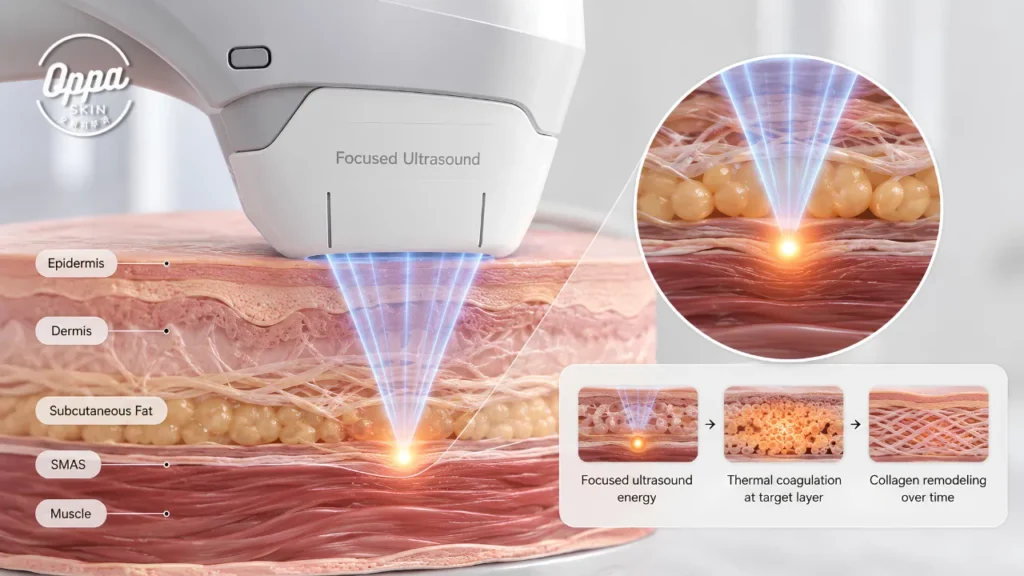
These include the Ultraformax and Ulthera programs, which use focused high-frequency sound waves (HIFU) to deliver energy to the skin and SMAS layers without damaging the upper skin layers. A key feature of this group is its ability to focus energy deep enough to reach the same depths as surgical thread lifts or facelifts in some cases, making them often considered for individuals with moderate to severe skin sagging.
Monopolar RF group
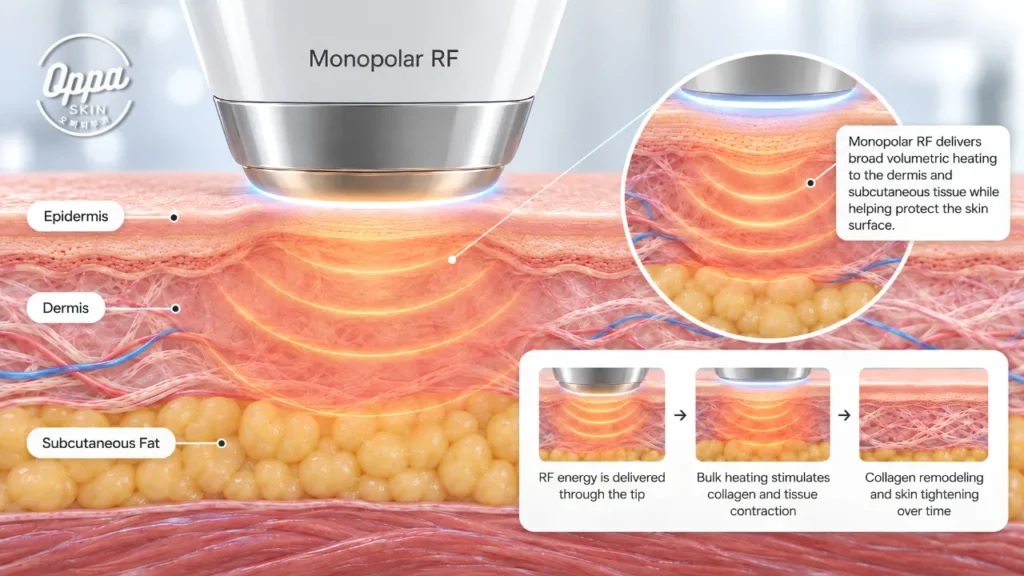
These include Thermage, XTherma, and Oligio programs, which use radio frequency waves to distribute heat evenly across the treated skin area, rather than focusing it on specific points like HIFU. The primary mechanism is to stimulate the immediate contraction of existing collagen to a certain degree, along with stimulating the long-term production of new collagen. A key advantage of this group is that the treatment is generally more comfortable than HIFU, and it allows for more consistent treatment of larger areas.
RF Microneedling Group
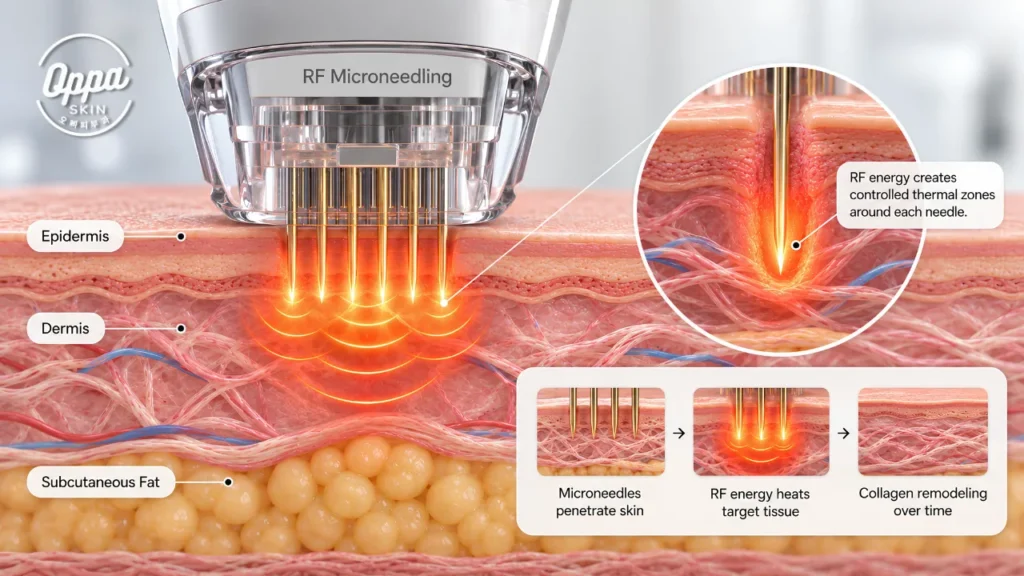
One example is the Potenza program, which uses microneedles to deliver RF energy directly to the desired skin layer through the needle tip. A key feature is the ability to adjust the needle depth according to skin thickness and the treatment area. Therefore, it is often considered for those seeking to address both skin firmness and other skin quality concerns simultaneously.
What types of skin tightening devices are suitable for which problems?
Each technology has its advantages, suitable for different skin problems. Doctors will determine suitability based on an individual skin assessment. The following guidelines are commonly used in this consideration:
Which Device May Suit Sagging Cheeks and Loose Skin?
Focused ultrasound treatments, such as Ultraformax and Ulthera, are often considered top choices for moderate to severe cheek and skin sagging because the energy can be focused down to the SMAS layer, a structural layer directly involved in cheek sagging.
Which Device May Suit an Undefined Jawline or Double Chin?
An undefined jawline or double chin may be related to sagging skin, fat, and chin structure together. If sagging skin is a significant factor, a skin tightening device suitable for that area may be considered. However, skin tightening doesn’t always correct excess fat or chin structure, and it’s not always necessary to use multiple devices together.
Which Device May Improve Firmness and Elasticity?
For those who don’t yet have significant sagging but want to maintain skin firmness, monopolar RF treatments such as Thermage, XTherma, and Oligio are often considered. This is because they are more comfortable during treatment and easier to incorporate into a consistent skincare program.
Which Device May Suit Wrinkles and Skin Quality Concerns?
If you have uneven skin texture, wrinkles, or certain types of scars, RF Microneedling may be an option depending on the indications for use of the device. However, an assessment of the type of problem, skin condition, and recovery time is necessary; it shouldn’t be chosen solely based on the claim that it “treats multiple issues.”
Comparing Energy Delivery Depths
The depth of energy delivery is another factor that differentiates different types of skin tightening machines, as each machine delivers energy and measures depth differently.
| Program | Energy delivery depth |
|---|---|
| Ultraformax | Treatment tips are selected for depths such as 1.5, 2.0, 3.0, and 4.5 mm. |
| Ulthera | Focused energy at depths of 1.5, 3.0, and 4.5 mm. |
| Thermage | Heat is applied to the tissue in targeted areas, not at a fixed depth like HIFU. |
| XTherma | Monopolar RF is used to generate bulk heating within a tissue volume. |
| Oligio | Monopolar RF 6.78 MHz is used to deliver thermal energy into the tissue. |
| Potenza | The depth depends on the needle setting and is adjustable from approximately 0.5 – 4.0 mm. |
6 Skin Tightening Devices: When to Expect Changes
Each type of skin tightening device takes a different amount of time to see results because the energy patterns and collagen stimulation processes differ. Some people may feel tighter skin initially, but changes from collagen production and restructuring usually become more noticeable over several weeks to months.
| Program | When changes may first be noticed | When changes may become clearer |
|---|---|---|
| Ultraformax | It might become noticeable in the early stages. | Results gradually become clearer in approximately 1 – 3 months. |
| Ulthera | Gradual change. | Approximately 1 – 3 months, and may continue to develop up to 6 months. |
| Thermage | Some people may feel their skin is tighter after the procedure. | Results gradually become clearer over approximately 2 – 6 months. |
| XTherma | Data on collagen changes is available from approximately 30 days. | It changes gradually as part of the collagen production process. |
| Oligio | Changes may be assessed from approximately 4 weeks. | It usually becomes more visible around 8 – 12 weeks. |
| Potenza | The changes will be gradual and take approximately 4 – 6 weeks. | Changes in skin quality may become more noticeable in about 12 weeks. |
What Treatment Feels Like with These 6 Devices
The sensation during the procedure is another factor that many people worry about before deciding. The level of sensation varies from person to person, depending on their sensitivity, the area being treated, and the energy level chosen by the doctor. At OPPA SKIN CLINIC, we offer free local anesthetic cream. The doctor will consider the energy level and the area being treated to minimize discomfort during the procedure and make it suitable for each individual.
- Focused Ultrasound: This type of ultrasound often produces a tingling, stinging, or dull pain when energy is delivered to deep tissue levels, because it delivers energy in a focused, targeted manner.
- Monopolar RF group: Typically provides a warm to hot sensation that is distributed evenly across the area, unlike Focused Ultrasound where the sensation is more concentrated in a specific point.
- RF Microneedling: You may feel both the needles and the heat from RF energy. The doctor may use a local anesthetic before treatment when appropriate.
What are the differences between the Ultraformax program and the XTherma program at OPPA SKIN CLINIC?
The Ultraformax and XTherma programs both aim to address facial sagging and firmness, but they use different types of energy and delivery methods, making them suitable for different skin problems and conditions.
| Points of comparison | Ultraformax Program | XTherma Program |
|---|---|---|
| Technology | HIFU | Monopolar RF |
| Energy delivery | Energy is concentrated at specific points along a given depth. | Distributing heat within the volume of the tissue. |
| Energy delivery depth | Multiple tip sizes are available, such as 1.5, 2.0, 3.0, and 4.5 mm. | Does not have a fixed depth in millimeters as HIFU does. |
| Concerns commonly considered | Sagging lower cheeks, undefined jawline, chin area, and tissue looseness. | Early loss of skin firmness, reduced elasticity, and general sagging. |
| Sensation during treatment | You might feel a tingling, stinging, or deep tightness in a specific spot. | It is usually felt as a warm to hot sensation spreading throughout the area. |
| Principles of selection | Focus on selecting the location and depth of the energy. | Focus on heating the tissue in a targeted area. |
What should you consider before choosing a facial lifting device?
Besides choosing a technology suited to your skin concerns, consider the following before deciding on skin tightening treatment:
- Medical history and specific contraindications: Please disclose any pre-existing conditions, medications used, pregnancy, breastfeeding, skin problems, and implantable devices such as pacemakers for evaluation according to the procedure’s requirements.
- Previous procedure history: Please specify the type, area, and time of treatment, including fillers, collagen stimulants, thread lifts, or surgery.
- Expected outcomes: Understand that results vary, and certain levels of laxity may exceed the machine’s capabilities.
- Practitioner and Medical Facility: Choose a licensed medical facility and a practitioner who is knowledgeable about the equipment and has guidelines for managing complications.
- Recovery and follow-up: Understand aftercare, what to avoid, and how to contact the clinic if unusual symptoms occur.
Guidelines for Choosing a Skin Tightening Device at OPPA SKIN CLINIC
Because each facelift technology has a different mechanism of action and is suitable for different skin problems, selecting the right program cannot be based on the same criteria for everyone. At OPPA SKIN CLINIC, our medical team begins by taking a detailed medical history and assessing each patient’s skin condition, including the degree of sagging, skin thickness, co-existing skin quality issues, as well as their expectations and lifestyle, before recommending a suitable program. If the assessment reveals that the primary problem is moderate to severe sagging in the deep structural layers, the doctor may consider the Ultraformax program to address the root cause. For those who want to enhance firmness along with improving overall skin quality, or have mild to moderate sagging, the doctor may consider the XTherma program. In some cases, a combination of both programs may be recommended, depending on the assessment results and individual goals.
6 Skin Lifting Devices: Key Takeaways
The six facial lifting programs Ultraformax, Ulthera, Thermage, XTherma, Oligio, and Potenza, operate using different technologies: Focused Ultrasound, Monopolar RF, and RF Microneedling. Each group has its own advantages and is suitable for different skin problems. Therefore, no single technology is suitable for everyone. Choosing the right lifting device should consider the degree of sagging, co-existing skin problems, tolerance to treatment, and individual goals. A thorough evaluation by a specialist physician is necessary before making a decision to ensure the most targeted and appropriate treatment plan for you.
Frequently Asked Questions
HIFU vs. RF: Which May Suit Sagging Cheeks?
Generally, HIFU programs like Ultraformax and Ulthera are often considered top choices for sagging cheeks because their energy can focus on the SMAS layer, which is directly related to the structures causing cheek sagging. RF is often considered as a supplement for those who want to improve skin quality as well. However, the actual suitability depends on the degree of sagging detected, which should be assessed by a doctor.
What type of facial lifting device should someone with little facial fat choose?
Individuals with low subcutaneous fat may require particularly careful energy level adjustments, regardless of the chosen technology. Because the fat layer helps to absorb heat during energy delivery, physicians need to assess skin thickness and subcutaneous fat volume before determining the appropriate energy level for each individual. Energy levels should not be determined arbitrarily or based on others’ assessments.
What type of skin tightening device should someone with a double chin choose?
A double chin can be caused by a combination of factors, including fat accumulation under the chin and sagging skin. A doctor needs to assess the underlying cause before recommending a course of treatment. If the double chin is primarily due to skin sagging, Focused Ultrasound or Monopolar RF may be considered to tighten the skin in that area. However, if there is also significant fat accumulation, the doctor may consider additional fat management treatments as well.
Can Different Skin Tightening Technologies Be Combined?
In some cases, a doctor may consider combining more than one technology to address skin problems at multiple depths simultaneously. However, this combination must be carefully planned and evaluated by a doctor beforehand to ensure safety and optimal results. Multiple treatments should not be undertaken simultaneously without consulting a doctor.
How long should the interval be between each skin tightening treatment?
The optimal time interval between treatments varies depending on the technology used, energy level, and individual skin response. Because the skin needs time to recover and regenerate collagen after exposure to heat, you should not self-determine the frequency. Instead, consult a physician to plan the appropriate frequency based on your skin condition and individual goals.
Is Deeper Energy Delivery or a Higher Shot Count Better?
Not always. The depth must match the target tissue, and the number of shots must be considered in conjunction with the area size, energy delivery pattern, and the device used. Therefore, figures from different machines cannot be directly compared to conclude cost-effectiveness or results.
Back to Articles